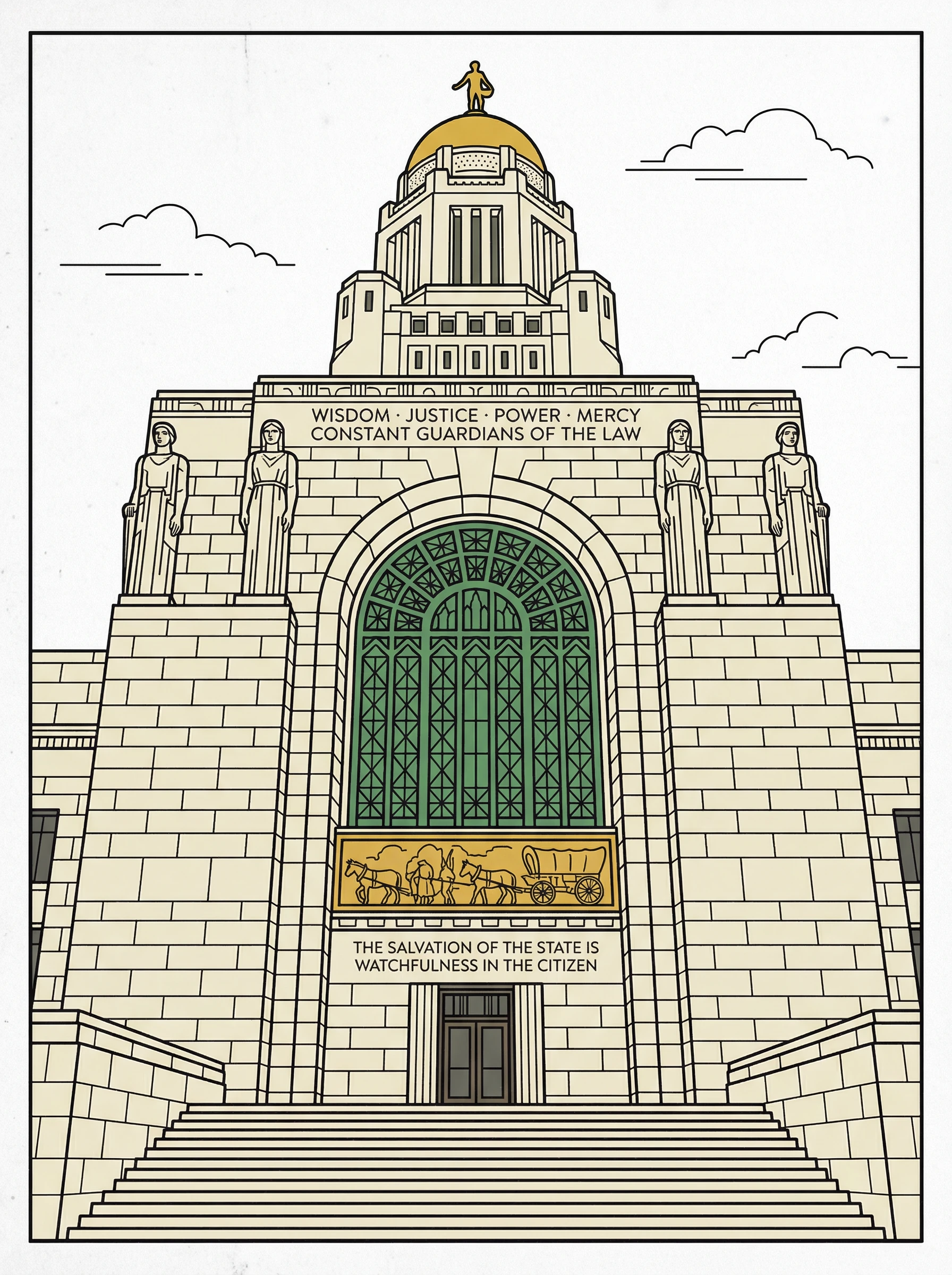
The maverick who sketched skyscrapers while everyone else drew domes.
Before Nebraska, Bertram Grosvenor Goodhue (1869–1924) was already the kind of architect who made other architects nervous.
He didn't pick a lane. He built worlds — Gothic drama, Spanish Colonial Revival, then a late-career monumental style that pointed toward Art Deco before most people had a name for it.
Then Nebraska asked for a capitol. And Goodhue said: *what if we don't do a dome?*
The man behind the tower
Goodhue treated architecture like storytelling. Romanesque weight where it needed gravity. Gothic verticality where it needed reach. Art Deco geometry where it needed to feel like the future — because in 1920, Nebraska *was* betting on the future.
He won the competition. He set the vision. He **died in 1924**, four years before the tower was finished.
That's the part that gets me. He never stood under the completed Sower. Never heard Lincoln argue about the nickname. But walk the building today and you're still inside his intent — because the team he assembled (mosaic artists, sculptors, philosophers) understood the assignment.
Goodhue elsewhere (keep clicking)
Lincoln is the pinnacle. It is not the only stop on the map. Official Capitol history and architectural records put these on his résumé — real places you can still visit:
**Los Angeles Central Library** (downtown L.A.) — Goodhue's other late masterpiece; LAPL calls the Capitol and the library his most innovative final-phase work.
**National Academy of Sciences Building** (Washington, D.C.) — same dream team: Goodhue + **Lee Lawrie** + **Hildreth Meière** (+ Albert Herter murals). Darwin bronze. Lyell bronze. Helios / sun-chariot hardware. This is the rabbit hole after Lincoln.
**Rockefeller Memorial Chapel** (University of Chicago) — commissioned in his lifetime; finished after his death.
**St. Bartholomew's Church** and **St. Thomas Church** (New York City) — earlier Goodhue / Lawrie collaboration territory.
**U.S. Military Academy chapel & campus work** (West Point, New York) — listed by the Nebraska Capitol Commission among his major works.
**Balboa Park / Panama-California Exposition** (San Diego, 1915) — Spanish Colonial Revival that still defines the park's look.
**California Institute of Technology** master-plan era work — campus bones with Goodhue fingerprints.
Nebraska didn't hire a regional drawer of domes. We hired a national architect at the peak of his nerve — and then he left us a building that outlived him.
What we know for sure
Goodhue's Capitol design was his **magnum opus** — widely considered among the most significant American buildings of the 20th century.
He collaborated with sculptor **Lee Lawrie** and mosaic artist **Hildreth Meière** — names you'll keep seeing on this series (safe on lore pages; we keep them off shop SEO).
Philosopher **Hartley Burr Alexander** helped shape the symbolism program — inscriptions aren't random; they're a curriculum carved in stone.
The Capitol Commission itself lists West Point, St. Thomas, St. Bartholomew's, the National Academy of Sciences, and the downtown L.A. library beside Lincoln as major works.
Dad-joke energy, dead serious craft
Picture other architects in 1920 sketching bigger domes on napkins. Goodhue was probably muttering, "Domes are so last century." Corny? Sure. Also basically true.
Nebraska didn't hire him to fit in. We hired him to **stand out**. And when you stand 400 feet tall on flat land, people notice.
Your homework
Next time you're at the Capitol, pick one facade detail and ask: *would a dome-builder have put this here?* Goodhue's answer is always no — and that's the whole personality of the building.
Then open the D.C. rabbit hole. Same cast. Different zip code.
The Capitol Commission keeps the tower’s official history, team bios (Goodhue, Lawrie, Meière), and visitor facts. When we rabbit-hole into Art Deco, this is the primary source we point back to.
Strategic Command posts its own public briefings and symposium notes from Offutt. Start here when you want deterrence news from the command — not a rewrite of someone else’s article.
Base life, weather-wing notes, and community updates land on the official Offutt site first. Local Lore tells the deeper story; this is the current bulletin board.